
Carolina and I met around 4 years ago while taught me about textiles, as at the time we worked for a textile artist in New York. Ever since I met her, I feel in love with her work. It has such richness to it, one I had not seen before in textile art. A mix of depth, texture, but most importantly composition.
I visited her in May, 2026 to have a little catch up and here is the interview.
Nathalie: What’s the name of this beautiful piece? (shown on hero image)
Carolina: This one’s called Blush.
Nathalie: And what does that stand for?
Carolina: I started this piece back in February. I was thinking a lot about motherhood and my daughter, and trying to capture as much as I could about this time. What’s been interesting is how much of early motherhood feels like stillness and hecticness, both at once — one minute you’re doing a million things, and the next you’re just cuddling the baby, watching them sleep. And in that stillness you have so much time to think about how they’re here, and just wonder at them.
I was looking at my daughter’s face, the pink in her cheeks, and thinking about this whole life she’s going to have — the whole world inside of her. So I made a series of landscapes, in color, to represent the different worlds she contains. That’s why it’s called Blush.
Nathalie: The lilac gives me such a sense of tranquility, like something calming and precious. And then the green, knowing you, makes me think of an Asian landscape, almost like matcha intertwining. And this one feels like a Mexican sunset to me ( the yellow). I don’t know if that’s just because I know you, but the way the palettes are integrated is so beautiful. How do you choose your color palettes — what’s the process for understanding what goes with what?
Carolina: That’s the most intuitive part, honestly. I start with an idea, and then it shifts as I go, partly because of how the dyes turn out. In this piece, the lilac and the flesh tone are naturally dyed, and the pale yellow too. The rest are off the cone.
Nathalie: Remind me how you dye the yarn?
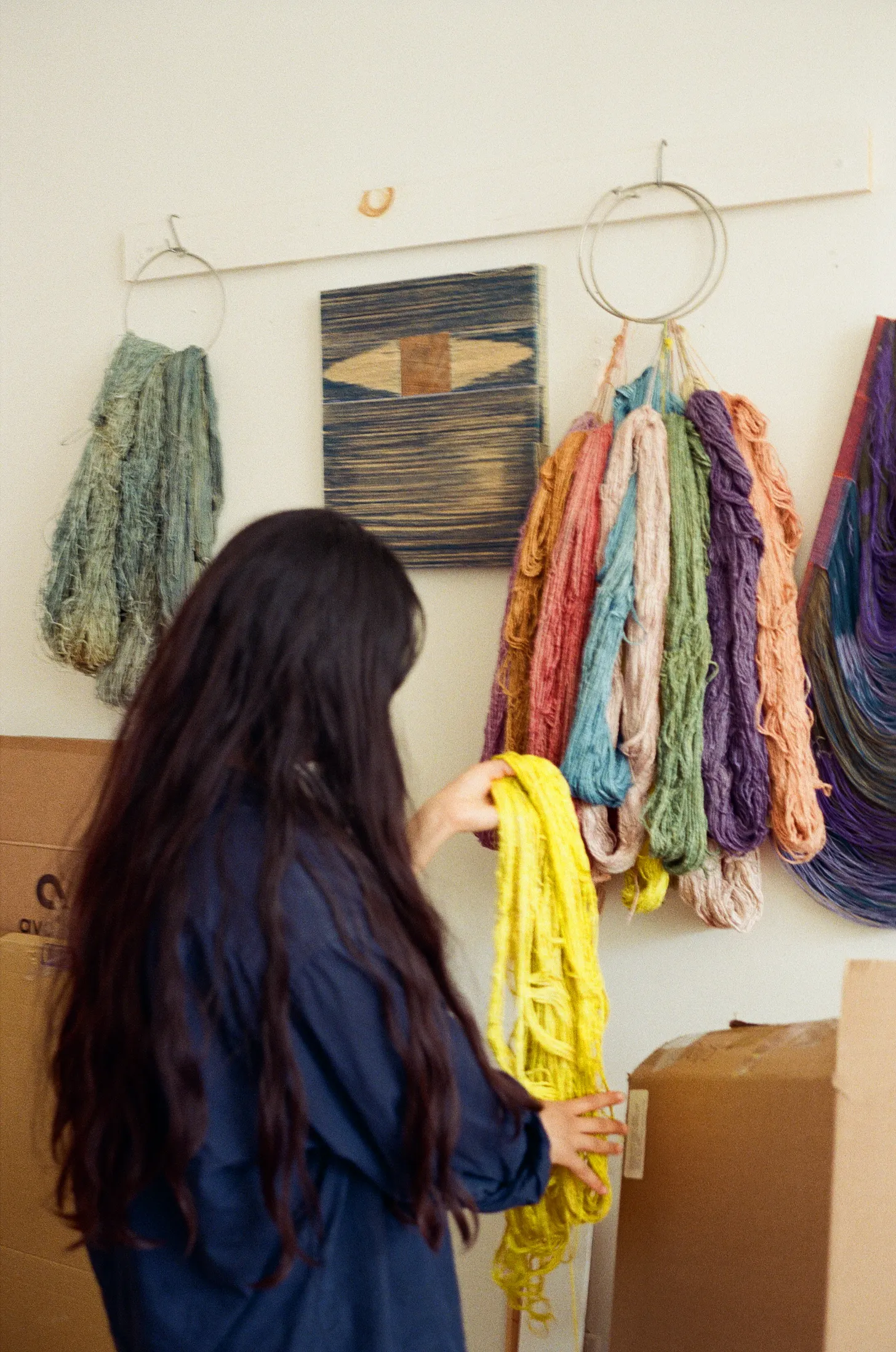

Carolina: It’s all natural dye for this piece, all silk. I use different extracts: cochinilla, madder root, weld, many different botanical extracts. The yarn starts as an off white.
First you wash it, that’s called scouring, then there’s a process called mordanting, so the dye will actually bind to the fibers. Only after that can you dye it. It’s a multi-step process, and you end up with all these different colors. It’s fun to work with the dye process because you can get close to the color you imagined, but as it dries the shade shifts. You’re figuring it out as it comes out of the dye pot, responding to whatever you’re given.
Nathalie: Did you have this shape already envisioned as you were weaving, like this part that looks like a mountain, or is it more of a feeling as you go?
Carolina: It depends on what I’m weaving. Sometimes I have an image in mind and have to plan a bit, but there are still decisions I’m making as I go. Other times I just know the shape or size, and the rest I figure out along the way.
Nathalie: There’s something so fascinating about your color palette. I’m someone drawn to muted colors like pastels and earthy tones. These feel so tranquil to look at. For this collection inspired by your daughter, how many pieces are there?
Carolina: There’s this large one, and then five smaller ones. These pieces have a lot more vibrancy here than I’d normally use. Together, it feels new to me — strong but beautiful, I think. The combinations surprised me too.
Nathalie: Who are your biggest inspirations right now?
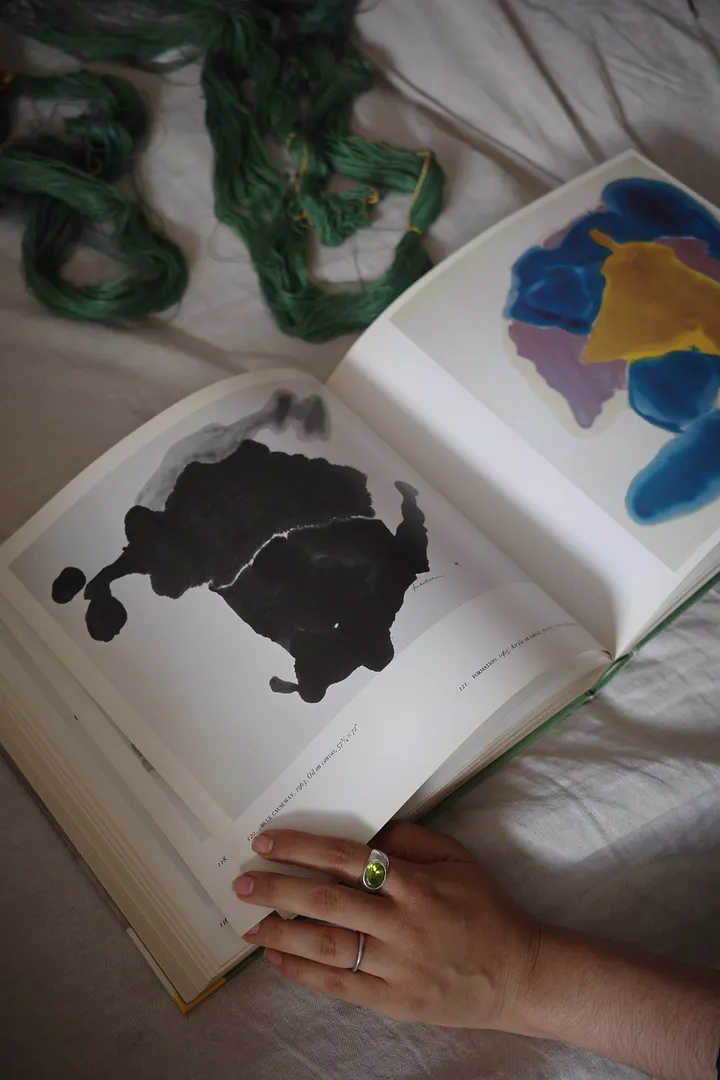
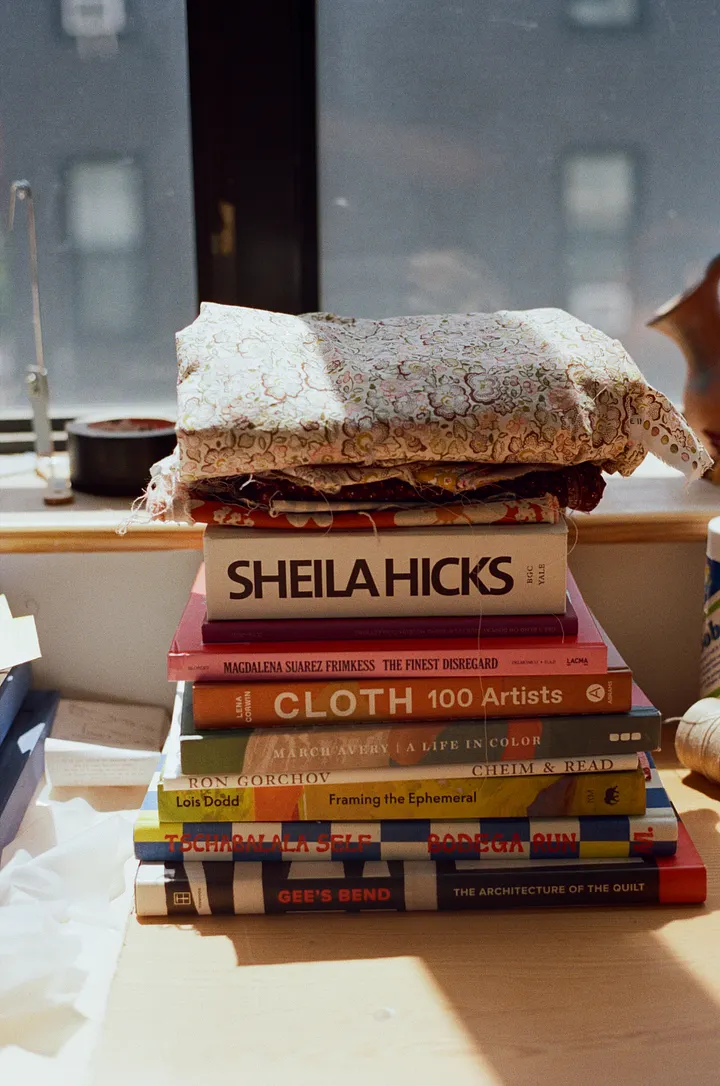
Carolina: I’m always drawn to painters more than textile artists, honestly. Though, I do love the Gee’s Bend Quilters. It’s also nice to look at historical textiles. Right now I’m thinking a lot about Lois Dodd, and about Robert Rauschenberg’s Jammers series specifically. And Delcy Morelos, do you know her work? There was an incredible installation of hers, I think in Chelsea a couple of years ago with straw scented with cinnamon, this monumental shape you could walk around, almost enter, but not quite go all the way inside — you’d just get pinched by it. I’m thinking a lot about how to use textiles in a more architectural way, which fits, given my background.
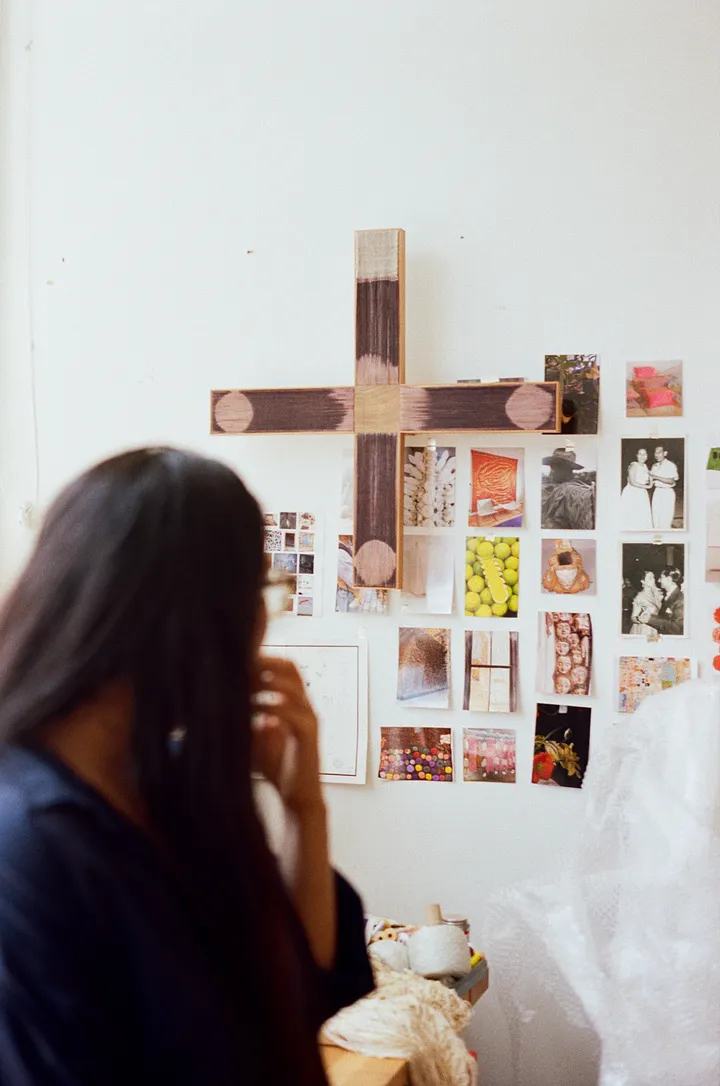
Nathalie: What about these cross-like forms we were just looking at — is there a religious thread there, or is it purely about form?
Carolina: It’s purely form, though it’s funny a lot of my work ends up feeling religious anyway, just because of the forms. When I’m trying to distill a moment into this monumental presence, there’s a simplicity, a directness, that people read as religious — something pure. I’m also thinking a lot about the body, our bodies, and when that gets mapped onto a shape, it often ends up looking like a crucifix. So people assume it’s about a cross, but that’s not really what I was thinking. I was thinking about relationships, family relationships, the push and pull between family members.
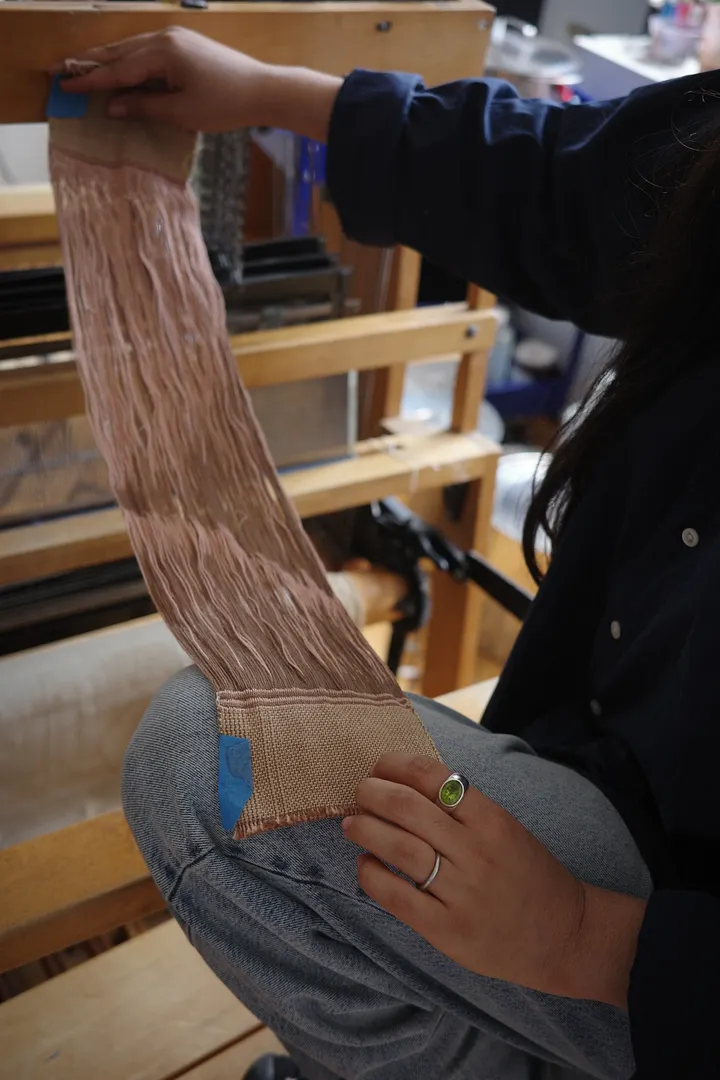
Nathalie: How did you create the different shapes within those woven pieces?
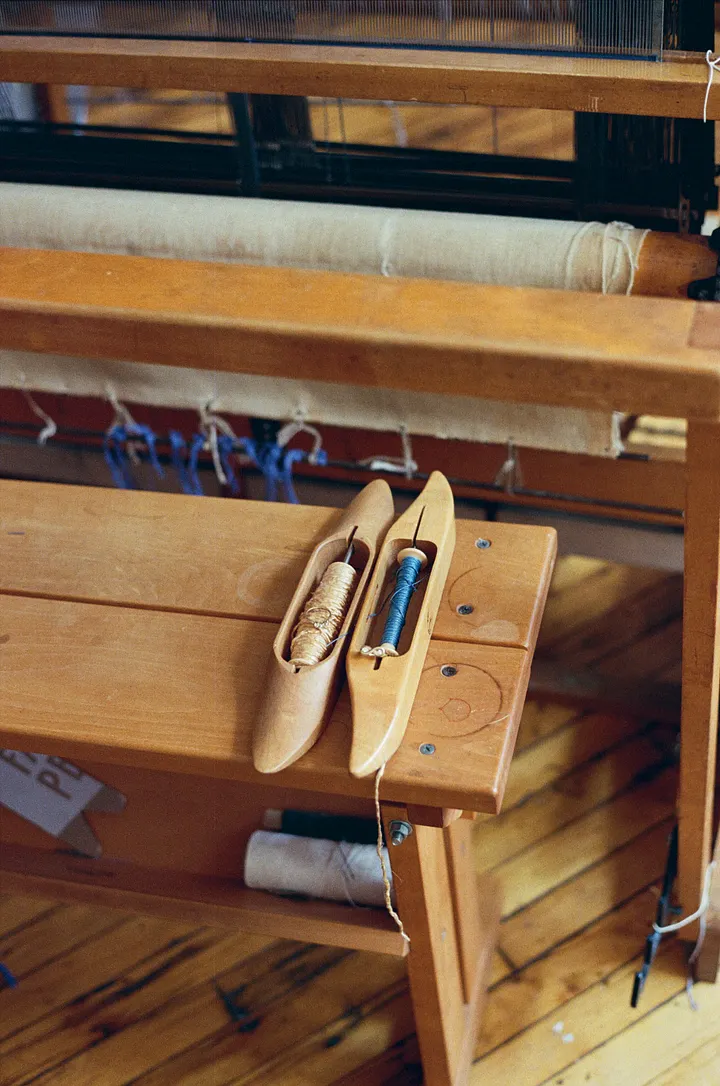
Carolina: That’s a simple weaving technique. Normally when you weave, the weft — what runs left to right on the loom gets packed down tight. But here I use the weft to pull up large amounts of the warp, the threads running front to back, and that’s what creates the shape, rather than leaving little gaps. If you look closely, there’s a tiny, thin strand of silk holding the two colors together, one above the other. If you took it off the loom, it would be very loose — without the edge pieces that anchor it to the stretcher, it would basically fall apart. You have to weave it while it’s already under tension.
What I’m really trying to describe is how fleeting these moments can be — how ephemeral. The fabric is barely held together, and I think that’s what memory is like too — barely there, and you’re trying to hold onto it, make it concrete. That’s part of my process: distilling moments into something I can hold onto, even briefly.
Carolina: (laughs) That’s such a huge compliment — that’s exactly the feeling I want: stillness, grounding.
Nathalie: What’s next for you, are you fully done with this series?
Carolina: I am. This is actually the first time in over a year I haven’t had a deadline, which is amazing and a little disorienting… I’m still figuring out what’s next. Right now I’m interested in domestic space, interiors as I spent so much of the last year at home with my family. I’m not sure that feeling will carry through once I start making new work, but I’m interested in building spaces out of textiles, and thinking about how the body sustains life.
Nathalie: Motherhood is so powerful in that way, like understanding the process of bringing life into the world.
Carolina: It really changes everything — emotionally, physically, mentally. You birth a human, but I feel like part of you is also being reborn. I’m still figuring out who I am now. At the very beginning, you’re just consumed by this new life. I chose to breastfeed her, and was lucky to be able to. So even though she was outside my body from day one, I was still sustaining her life directly and there’s a different kind of connection there. From my body to hers. Every week as she grows, it’s a little bit of a shock, of how am I doing this?
Now, coming up on her first birthday, everything is shifting again as she becomes more independent. But even before I was pregnant, my work was always interested in the generational passing-down of stories, history, traditions, culture. I used to be only on the receiving end of that. Now I’m thinking about what I pass on too — instead of being an endpoint, I feel like a bridge. That’s a different space to inhabit. I’m not just a receptacle for all of it anymore — I’m filtering it.

Nathalie: I think that’s what’s so special about people like you who stay devoted to craftsmanship, working with techniques passed down through generations. It carries so much emotional weight, but also legacy, family history, the immigrant experience. All the way cultures intertwine into a new life and change how you sense the world.
Carolina: I think it’s part of being sensitive and maybe that’s why we’re creative. You see things so microscopically, or so abstractly, compared to how day-to-day life looks to other people.
Nathalie: I love your work. Where can people find it if they want to buy a piece? Carolina: They can reach out to me directly, and I can point them to wherever the work currently is, it moves around. Some is at a gallery in New York, some elsewhere. Honestly, I need to make a lot more since a lot has left the studio in the past few months, which I’m grateful for, but I slowed down for a while and now it’s time to get back in gear!
Thank you Carolina, I’m excited for what’s next.
N